
Tropical North Insurance Experience
Insurance Affordability and Availability in Tropical North Queensland
Supporting regional communities and businesses through evidence-led advocacy
Access to affordable and appropriate insurance remains a significant challenge for households, businesses and communities across Tropical North Queensland. Rising premiums, limited insurer choice and concerns about underinsurance have implications for regional liveability, resilience, business continuity and future economic growth.
Since 2025, Regional Development Australia Tropical North (RDATN) has undertaken regional insurance surveys, contributed to national inquiries and collaborated with other Regional Development Australia organisations to ensure the experiences of Northern Australians are represented in insurance policy discussions.
National Insurance Monitoring and the Cyclone Reinsurance Pool
In 2022, the Australian Government established the Cyclone Reinsurance Pool to help improve insurance affordability and availability in cyclone-prone regions.
The Australian Competition and Consumer Commission (ACCC) was tasked with monitoring insurance prices, costs and insurer profitability, including whether savings generated through the Pool were being passed on to policyholders.
The ACCC released five monitoring reports between 2022 and 2026, with its final report published on 25 June 2026.
While the ACCC found that the Pool had reduced or moderated premiums in higher cyclone-risk areas, it also acknowledged that insurance affordability remained a significant concern, particularly across Northern Australia.
2025 | Bringing Regional Experiences to National Attention
Recognising the growing challenges faced by households and businesses across Tropical North Queensland, RDATN conducted its first regional Insurance Experience Survey in early 2025.
The survey gathered 224 responses, providing valuable firsthand insights into the impacts of insurance premiums, limited availability and the difficulties associated with maintaining adequate cover.
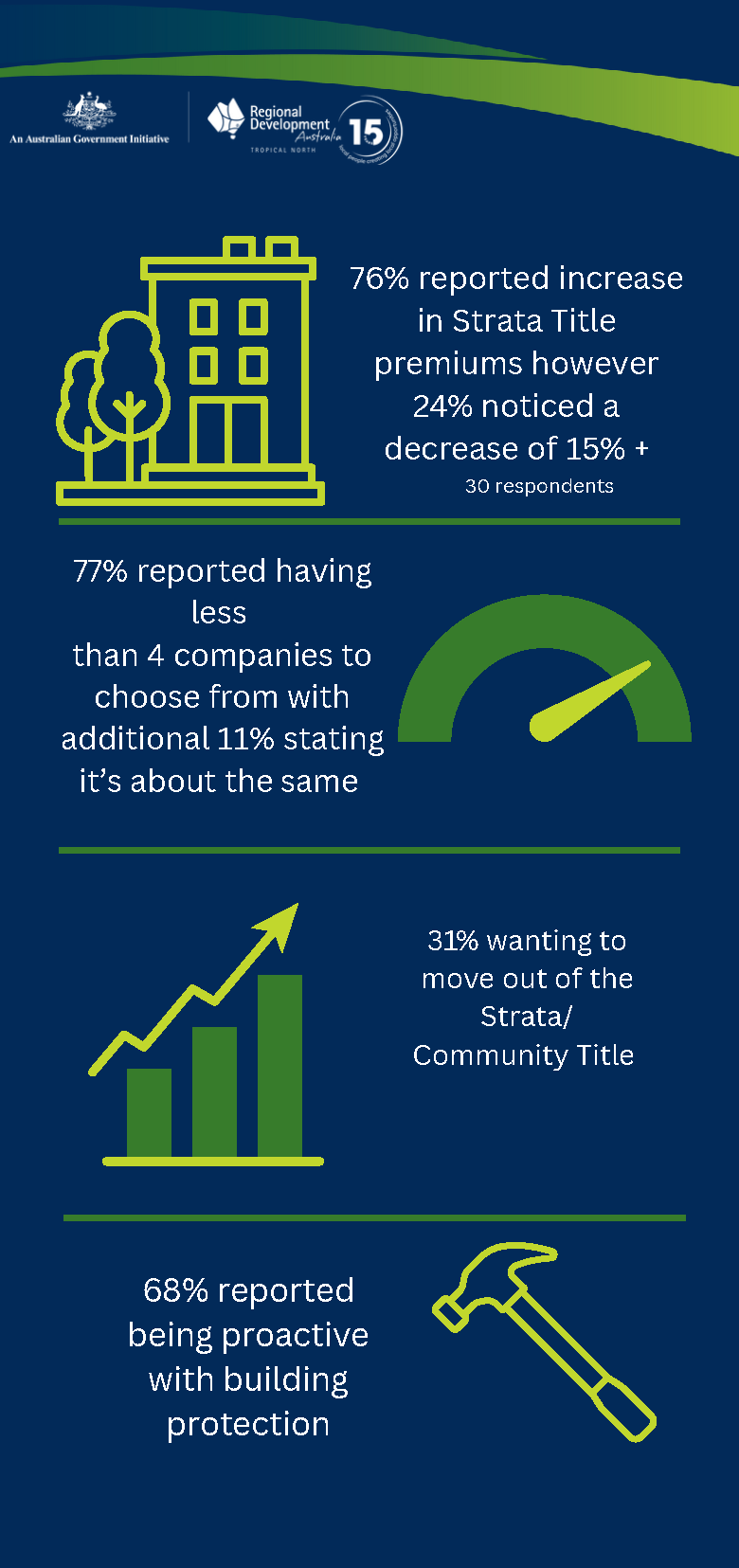
The findings highlighted financial stress, underinsurance and deferred property maintenance, alongside concerns that investments in cyclone mitigation were not consistently reflected in insurance premiums.
RDATN submitted its findings to the ACCC on 31 March 2025, helping bring regional experiences directly into the national monitoring process.
Importantly, RDATN’s findings were featured in the ACCC’s July 2025 Insurance Monitoring Report, demonstrating the value of regional intelligence in informing national policy discussions.
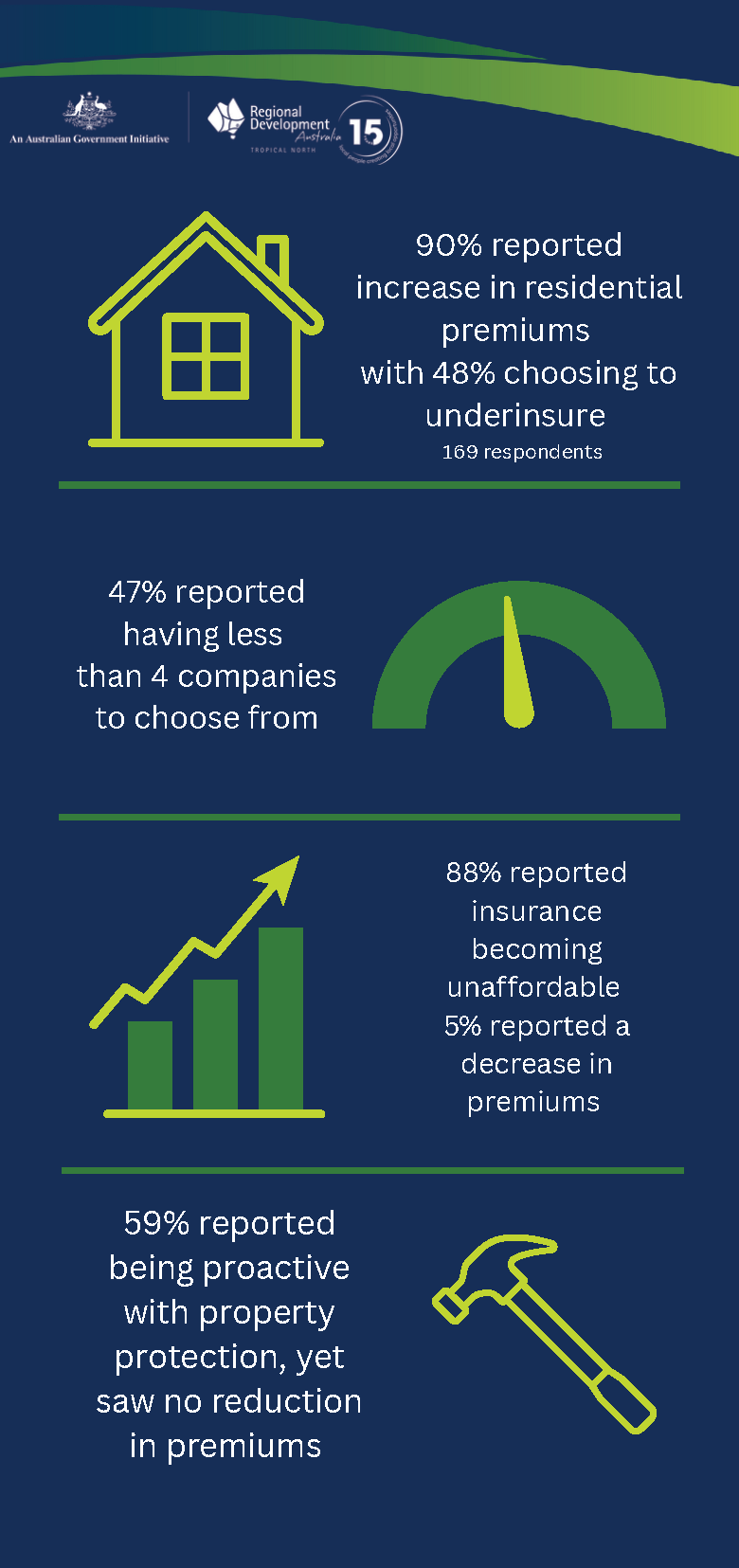
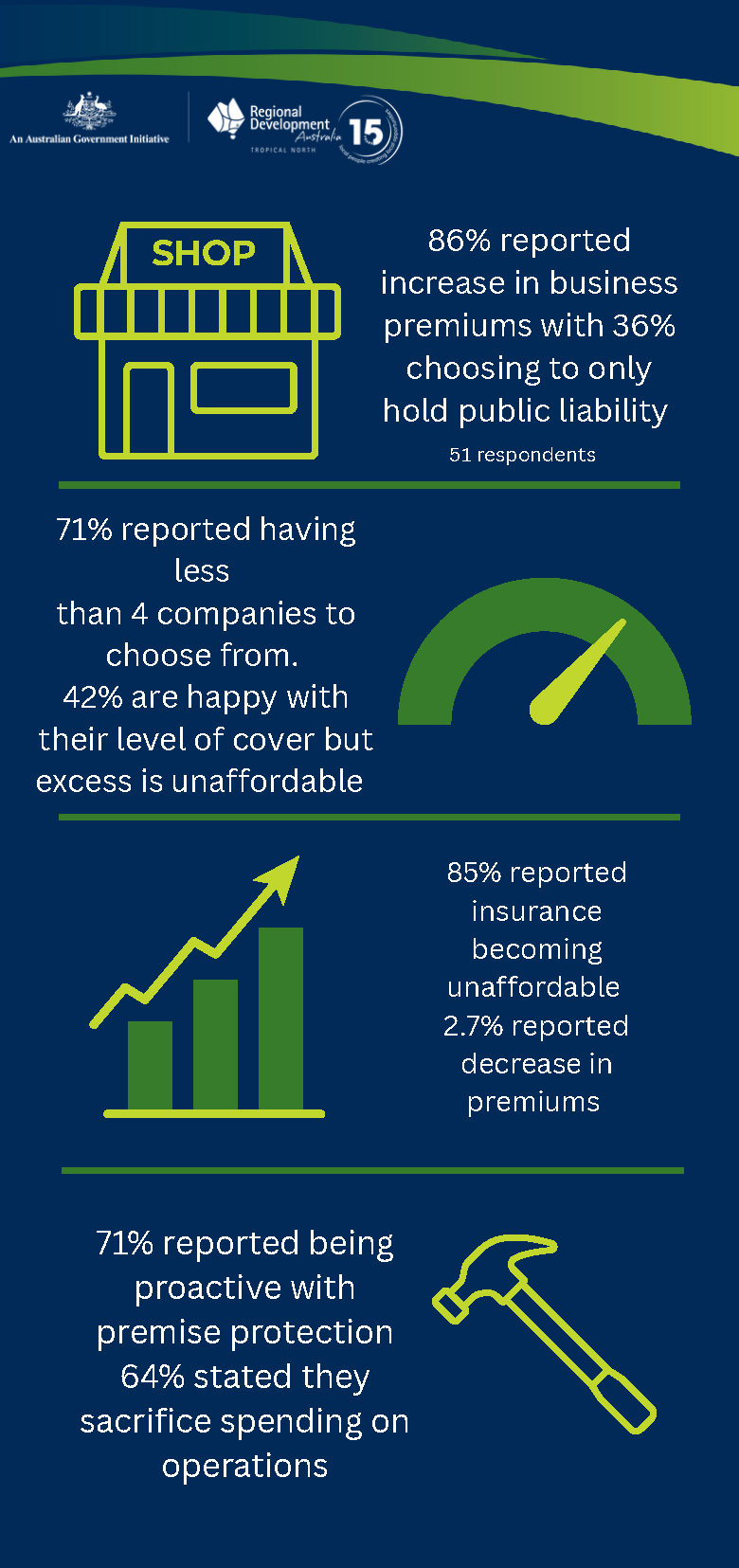
2025 RDATN Submission to ACCC Insurance Monitoring Report | Infographics
2026 | Continuing the Advocacy
Although the ACCC’s formal monitoring concluded in June 2026, the challenges facing regional communities had not disappeared.
In August 2026, the Australian Parliament’s Joint Standing Committee on Northern Australia invited further submissions on the implementation and effectiveness of the Cyclone Reinsurance Pool as part of its inquiry into Preparing for Emerging Industries across Northern Australia.
This provided an opportunity for RDATN to revisit its earlier findings and continue advocating for fairer, more affordable and accessible insurance for northern communities.
RDATN reopened its Insurance Experience Survey to gather updated intelligence from residential property owners, businesses and strata communities.
The renewed survey sought to understand how insurance costs were influencing household financial resilience, business operations, investment decisions and the region’s readiness for future economic opportunities.
The 2026 survey recorded 83 entries across seven Tropical North Queensland local government areas, providing an updated perspective alongside the original 2025 findings.
Strengthening Northern Australia’s Voice Through Collaboration
Insurance affordability is not a challenge singular to Far North Queensland but is shared across Northern Australia. RDATN collaborated with other Regional Development Australia organisations through the Northern Regional Development Australia Alliance (NRDAA) to gather Northern Australia wide intel on insurance.
This coordinated effort enabled participating regions to gather comparable evidence and contribute to a broader understanding of insurance pressures affecting northern households, businesses and communities.
Participation varied across regions, with the collaborative survey recording 232 survey entries across six RDA regions and the Indian Ocean Territories Regional Development Organisation. Of these, 227 entries from five regions contributed to the substantive regional analysis.
The collective findings strengthened the evidence available for advocacy and informed a coordinated NRDAA submission to the Joint Standing Committee on Northern Australia.
The collaboration demonstrated how the RDA network can amplify individual regional voices and identify common challenges requiring a coordinated national response.
What the Survey Findings Revealed
The 2026 Tropical North Queensland survey reinforced many of the concerns first identified in 2025.
Among participating residential respondents:
- 96.9% (62 of 64) reported insurance premium increases.
- 89.7% (52 of 58) indicated that insurance was becoming unaffordable.
- 68.4% (39 of 57) reported stress associated with insurance costs.
- 73.7% (42 of 57) reported undertaking protective measures without noticing a corresponding premium change.
Business responses also highlighted concerns about affordability and the implications for regional economic activity. All 12 respondents answering the business affordability question considered insurance to be becoming unaffordable. Eight reported sacrifices affecting operations, staffing or productivity, while six reported impacts on business expansion or investment.
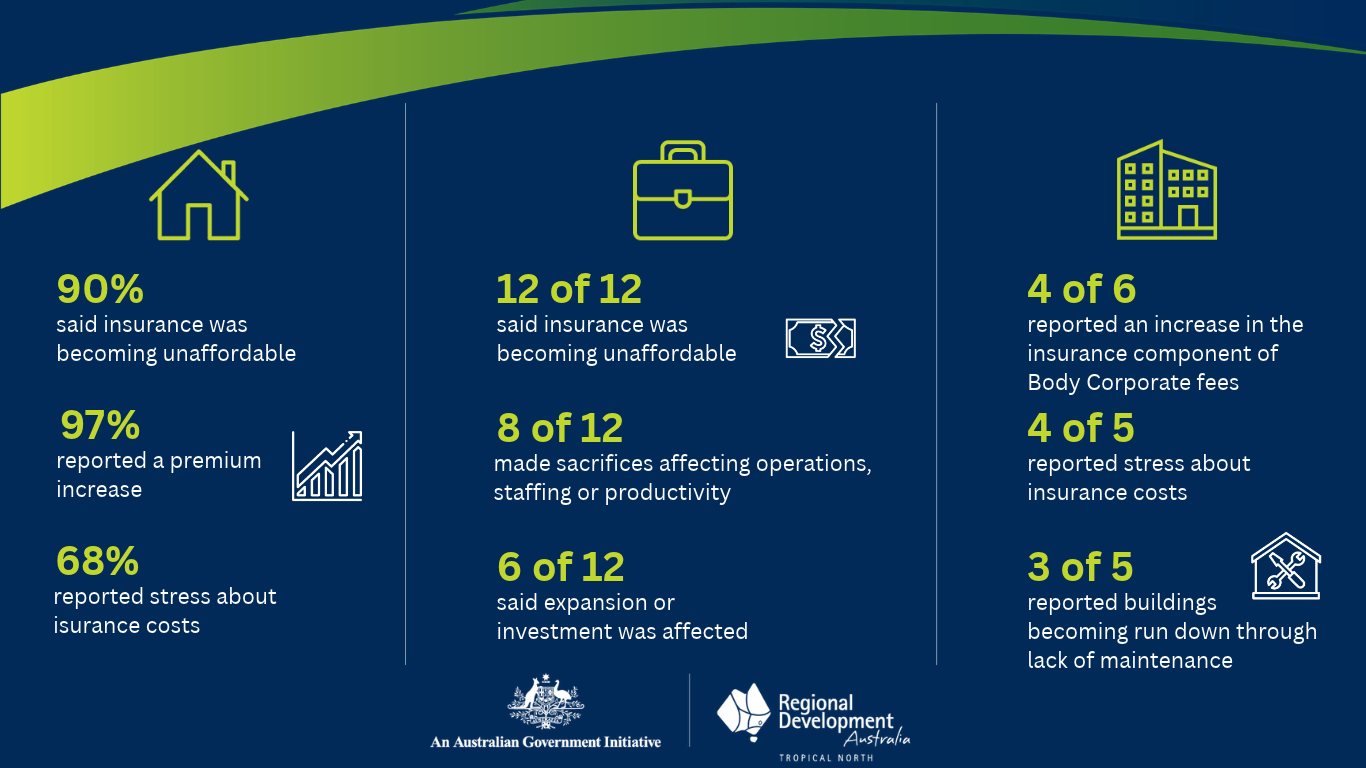
RDATN Insurance Experience Survey 2026 | Infographics
83 responses. Counts vary by question. Findings describe survey respondents. Percentages are rounded.
A Consistent Picture Across Northern Australia
The broader NRDAA findings identified similar pressures across participating northern regions.
Across the combined residential responses, approximately 93% reported premium increases and 88% considered insurance to be becoming unaffordable. Business respondents also identified pressures affecting operations, investment and access to suitable insurance cover.
These findings highlight the importance of considering insurance affordability not only as a household cost-of-living concern, but also as an issue influencing regional productivity, investment confidence, workforce attraction and community resilience.
The surveys were voluntary and self-selecting. Results reflect participating respondents’ experiences rather than population-wide estimates.
Ongoing Engagement and National Advocacy
RDATN continues to engage with relevant agencies and regional stakeholders to communicate local insurance experiences and advocate for improved outcomes.
In October 2026, RDATN met with representatives of the Australian Reinsurance Pool Corporation (ARPC) to discuss the regional insurance survey findings and continuing affordability and availability concerns.
RDATN’s advocacy includes support for greater transparency around premium pricing, better recognition of cyclone mitigation measures, stronger commercial insurance outcomes and continued independent monitoring following the conclusion of the ACCC’s formal monitoring program.
Through collaboration with the NRDAA and our continued efforts with agencies including the Australian Competition and Consumer Commission and the Australian Reinsurance Pool Corporation, RDA Tropical North aim to ensure regional experiences inform ongoing monitoring and the statutory review of the Cyclone Reinsurance Pool, with a focus on achieving stronger commercial outcomes for our region and northern Australia.
Why This Work Matters for Regional Development
Insurance affordability is more than a financial concern. It directly influences the ability of communities to recover from natural disasters, businesses to operate and invest, and families and workers to establish their lives in the region.
RDATN’s insurance advocacy aligns with the Tropical North Queensland Economic Development Strategy 2024–2029, particularly the priorities relating to economically sustainable emerging industries, better-performing foundation industries, and affordable and suitable housing.
It also supports the Australian Government’s Regional Investment Framework, recognising the interconnected needs of People, Places, Services and Local Economies.
This work demonstrates RDATN’s role in gathering regional intelligence, facilitating collaboration and ensuring local experiences inform government policy and investment decisions.
By connecting regional evidence with national decision-makers, RDATN continues to advocate for the conditions needed to support a resilient, productive and liveable Tropical North Queensland.